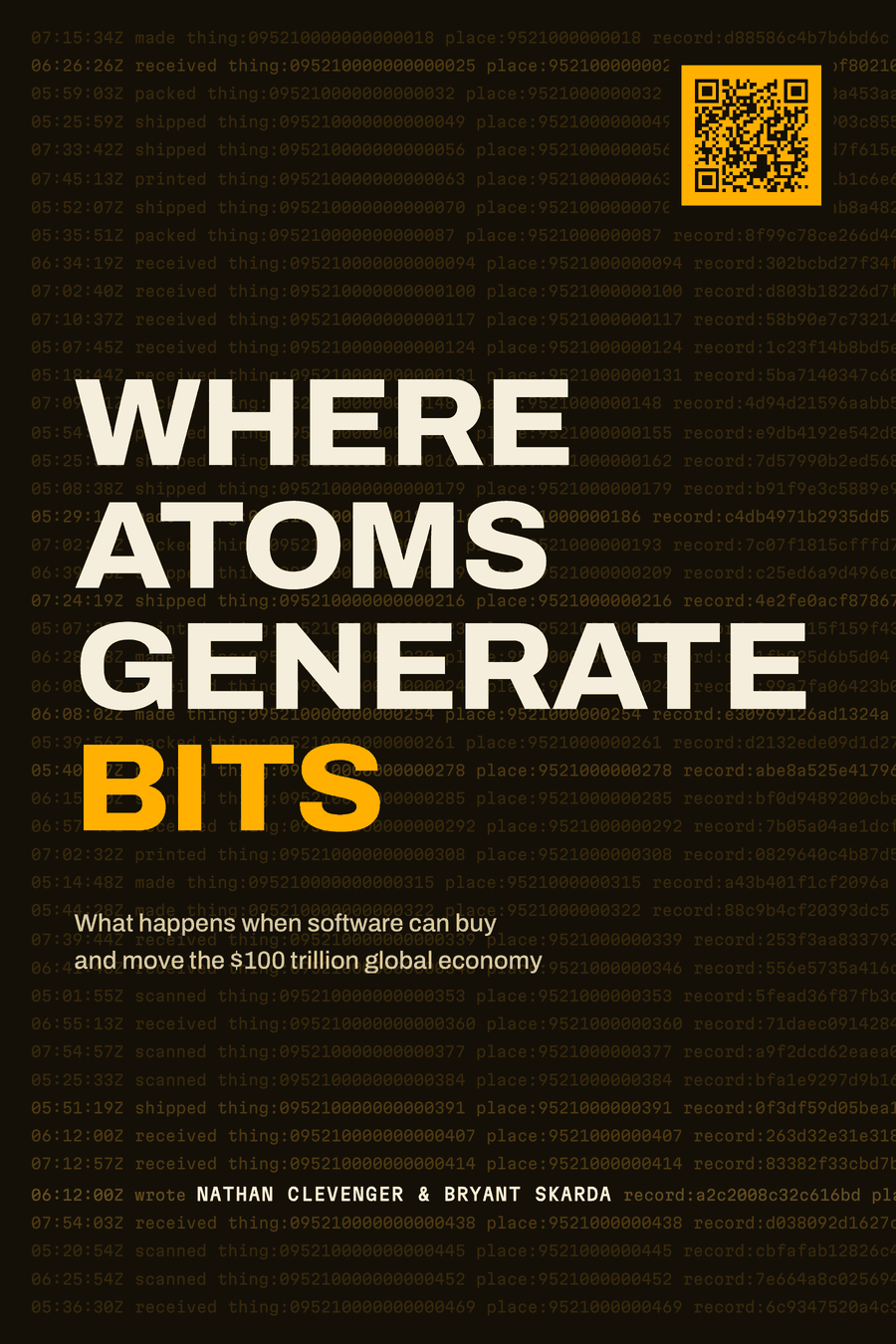
Where Atoms
Generate Bits
What happens when software can buy and move the $100 trillion global economy.
Nathan Clevenger & Bryant Skarda
Then you pointed it at operations.
Not at the analytics on top of operations — you had already done that, and it had already worked. At operations themselves. At the part of the company that makes things, moves things, and hands things to somebody else. The half of the business that is most of the cost, most of the headcount, most of the risk, and most of the reason anyone pays you.
And nothing came back.
It was not a connector problem. It was not a data-quality problem, and it was not a maturity problem, and it was not that your people picked the wrong tools or scoped the pilot badly. Those explanations are all available and they are all wrong, and they are wrong in the same way: each of them assumes the information existed and something went wrong on the way to using it.
The information did not exist.
Not was not collected. Not was collected badly. Could not have been collected, by anyone, at any budget, in any of the systems you own.
Five passages.
-
Chapter 10 · The budget already pointed at it For the first time, the party who pays for the barcode is the party who loses if nothing can read it.
-
Chapter 11 · A decision that welds shut for a decade You can sample print quality. You cannot sample identity, and a barcode that did not read is a unit that does not exist in the record.
-
Chapter 18 · What an agent does when the record is thin An operation that cannot tell a reading from an estimate has not been failing to automate. It has been automating perfectly well, on a record that guesses — and filing the guesses.
-
Chapter 23 · What locks software out of the physical world Perception arrived without identity, and identity is the one part that cannot be inferred. You cannot look harder at a case and work out which one it is. Either it says so, or nobody knows.
-
Chapter 26 · The hand that stays in the loop An approval nobody can reconstruct afterward is not an approval. It is a click.
30 chapters, 5 parts.
It opens on an operation where reasoning worked everywhere except the half of the company that makes and moves things, and it spends the rest of its length on why, and on what would have to be true instead.
- 1The world as it is
- 2Why it held, and why it stops
- 3From stripes to squares
- 4The party in the middle
- 5What has to exist
What you get.
A 30-chapter book as a single file. It is a reading draft: US Letter, generous margins, chapters starting on new pages. It is not typeset at trim, and the filename says draft because the file is one. The words are finished; the typesetting is not.
It carries a glossary, and the diagrams the argument is made in. Nothing in it is behind anything else.
A note from Nathan Clevenger.
Why would anyone want to send a scan event to the cloud?
I was asked that more than once, in more than one building, by people good at their jobs. It was a fair question. Nothing was waiting at the other end. A man stood on a dock with a scanner in his hand, and he already knew what he had scanned.
I could not answer the question when it was asked. This is the answer.